Feature №5
EITHER there is more than one way of achieving a LOC;
OR a LOC may be defined using other LOCs some of which can be combined according to a set of combination rules.
This features is quite common for example in qualification structures, where a qualification can be awarded for covering a core set of modules plus a specified number of optional modules. General learning outcomes or competences can be achieved in several different ways. Which sources display this optionality, and which stakeholders need this optionality to represent fully the structures they use?
Note that we are not talking about about optionality of elements, but optionality or conditionality of LOC definitions in a structure.
Options are not common in existing explicit formal LOC structures. But informally there are many examples. At a high level, management competence can be achieved in a number of ways, through several different approaches. If we were to specify a structure for management competence, to be realistic it would have to include several options for these different approaches or styles. Most higher-level qualifications have options as part of their specification. This means that if we are to represent the overall learning outcome of, say, a degree course, it will have options in it. For example, a computer science degree could have options about which programming language is studied.
Illustration
To achieve exemplary competence in a particular area it is needed to achieve particular learning outcomes or competences (LOCs). LOC#1, LOC#2 and LOC#7 are mandatory, i.e. without having these LOCs it is not possible to get Competence A. However LOCs #3, #4, #5 are optional. Learner can choose whether to focus on LOC#3 or focus on both LOC#4 and LOC#5. LOC#6 is fully optional.
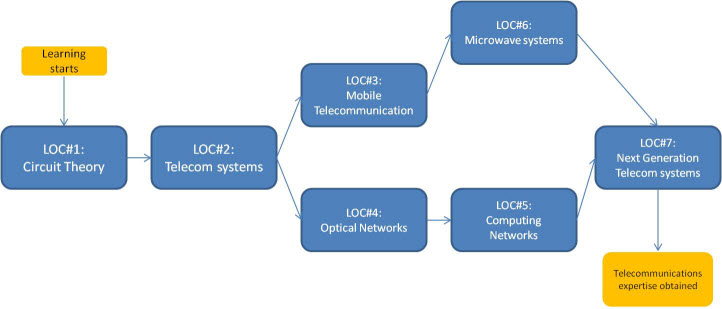
The exact regulations would be expressed in a combination rule for the desired overall outcome. A combination rule set specifies what it takes to assess a LOC at a higher level of granularity in terms of combinations of LOCs at lower levels of granularity. For instance, to attain competence as an engineer, a particular framework may specify that competence must be achieved in a set of necessary component units covering all the competences necessary in every branch of engineering, plus certain numbers of optional units covering some of the specialisms.
Combination rules are not needed where all the components are necessary.
InLOC examples
- UK QCF is a good example of including optionality, with many real examples
- The eCOTOOL model provides for optionality
InLOC treatment
Conditionality in InLOC is treated using the LOCrel LOCassociations with schemeid "isOptionalPartOf" and "hasOptionalPart".