Personal Achieved Learning Outcomes (PALO)
Introduction
The Personal Achieved Learning Outcomes (PALO) data model is a simple schema proposed to represent information on knowledge, skills and competences achieved by a person (a learner), and the relations between those outcomes. Furthermore, information on the context where the learning outcomes are obtained or applied, evidence records (assessment), and levels (e.g. proficiency level) associated to the outcomes are also part of this schema.
PALO was developed in iCoper eContentPlus EU project; beside the LOD schema.
General information
(see Example source guidance)
| information to be gathered | details |
|---|---|
| Name / title of source/model and version if applicable | Personal Achieved Learning Outcomes (PALO) |
| Stakeholder | iCoper eContentPlus project |
| URL | http://www.icoper.org/results/deliverables/D2-3 (Section 3.2.3) |
| Orientation | This data model represents information about a set of personal achieved or desired learning outcomes. In addition to information on evidence related to achieved learning outcomes, levels and context where outcomes are achieved. |
| Explicit / implicit | This is an information model and can represent info on explicit LOCs. |
| Organisational competence | NA |
| Number of people currently affected | |
| User communities | University administration, teachers and learners |
| Significant use cases | http://www.icoper.org/results/deliverables/D2-3 (Section 4.5.2), a proof of concept implementations in Moodle LMS is provided. |
| Significant business cases | |
| Sample materials | |
| Key features influencing uptake | PALO links LOCs to level, context and evidence data. This data is so important for InLOC and information captured in PALO should be covered in IlOC when relevant. The interoperability with PALO should be maintained. |
Features
(see the Features page or the separate pages for each feature)
| N | Features | ? | notes |
|---|---|---|---|
| 00 | More than one model | 1 | |
| 01 | Identifiers | 1 | |
| 02 | Hierarchy (internal) | NA | |
| 03 | Internal relationships | NA | |
| 04 | External relationships | 1 | |
| 05 | Conditionality / optionality | NA | |
| 06 | Text syntax | NA | |
| 07 | Structured identifiers | 0 | PALO uses a URI as identifier |
| 08 | Classification | NA | |
| 09 | Level attribution | 1 | This model represents a profile (set of personal LOCs) of a person. |
| 10 | Level definition | 0 | PALO represents data on levels whatever the level schema they belong to. The idea was to support attaching different level info to LOCs and not binding PALO to one level scheme. |
| 11 | Context | 1 | Data about several types of context information is represented. |
| 12 | Evidence and assessment | 1 | Data about several types of assessment and evidence information is represented. |
| 13 | Extensions | 0 | |
| 14 | Profiles | 1 | is possible to create a profile for desired outcomes |
| 15 | Adaptation | 1 | most elements are optional and can be adapted to needs of community |
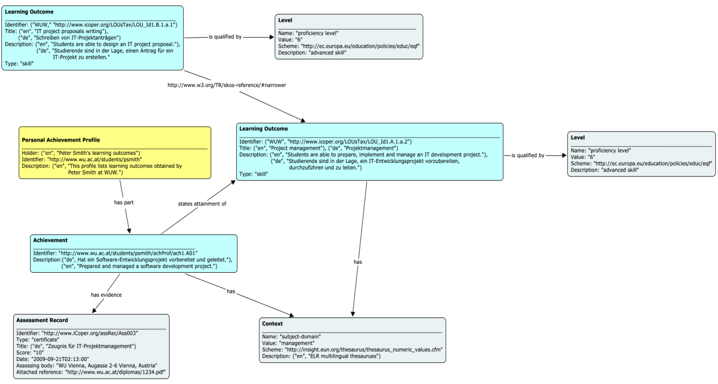
| 16 | Definition by example | 1 | See PALO instance example diagram below |
| 17 | Learning resources | 0 | |
| 18 | Learner records | 1 | only a link to evidence records |
| 19 | Multilinguality | 1 | Metadata of title and description info can be represented in several languages using LangString |
Any other or longer information
PALO Data Model
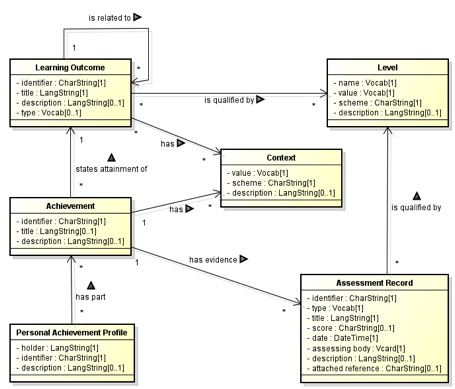
PALO Data Model v1.1
PALO Instance Example